

By Sebastian Mullins, Head of Multi-Asset and Fixed Income at Schroders Australia
For decades, investors operated under a comfortable assumption: asset allocation could be largely outsourced to a static formula. By blending growth assets with a fixed sleeve of government bonds, diversification was expected to smooth market turbulence. It was a simple framework, rooted in the predictable inverse relationship between corporate profitability and sovereign debt.
However, the structural pillars supporting that paradigm have cracked. The prolonged environment of low inflation, rock-bottom interest rates and predictable central bank liquidity has given way to a more volatile regime marked by persistent price pressures, aggressive fiscal spending and geopolitical instability. The market has been used to worry about demand shocks, but now we live in a world filled with supply shocks, which is an entirely different regime.
In this environment, traditional asset correlations have a dangerous habit of breaking down precisely when market stress peaks. Many investors still treat risk mitigation as a permanent, set-and-forget defensive bucket, allocating capital to a specific safe-haven and trusting it will provide protection whenever equities pull back. But when macro regimes shift, yesterday’s reliable hedge can quickly become tomorrow’s concentrated risk asset.
Successfully shielding capital today demands continuous tactical adjustments rather than static endurance. Managing downside risk must be treated as an active, evolving process that moves with markets.

Source: Schroders as of 31 December 2025
The trap of the static hedge: A tale of two crises
The danger of a passive approach to risk mitigation becomes obvious when analysing how different geopolitical disruptions have reverberated through markets over the past two years.
The market anxiety surrounding Liberation Day in 2025 was defined by a broad “Sell America” narrative. The US dollar weakened, international currencies such as the euro and Japanese yen strengthened, gold outperformed as an alternative store of value, and capital rotated away from US equities. Portfolios relying on precious metals and unhedged international exposures were rewarded, while long-duration bonds struggled.
Yet when tensions escalated into open conflict in Iran in 2026, the playbook flipped. The US dollar rallied strongly, gold sold off and underperformed, global investors rotated back into large-cap US equities and Treasury market dynamics reversed.
This divergence highlights a critical lesson: a defensive position is only effective if it matches the specific drivers of the current crisis. Gold behaves exceptionally well in a monetary debasement environment defined by rate cuts, fiscal stimulus and accommodative central banks. Broad commodity exposures, by contrast, tend to excel during acute supply-side shocks.
Maintaining a static hedge out of habit means accepting uncompensated exposure.

Source: UBS, Schroders
Navigating bonds, commodities and FX in 2026
At Schroders, we consciously avoid managing portfolios in isolated asset sleeves. Guided by our Total Portfolio Approach, we assess how the entire fund behaves under changing liquidity conditions, shifting yields and geopolitical events.
This philosophy shaped our approach throughout the volatility of 2026.
The Gold-to-Commodity Pivot
Early in the year, enthusiasm for gold became extreme as prices surged towards record highs. Recognising that the asset was approaching a near-term ceiling, we crystallised our gains and reallocated the proceeds into broad commodity exposure.
This proved valuable when conflict emerged in Iran and concerns over energy supply intensified. Supply-chain disruptions function as direct supply shocks that support commodity prices while creating short-term liquidity pressures for gold.
As conditions stabilised, we once again adjusted exposures, reducing broad commodity allocations and reintroducing gold. While gold can experience short-term headwinds during periods of acute market stress, its longer-term structural tailwinds remain compelling.
Navigating these waves demands constant agility, not a passive buy-and-hold mentality.
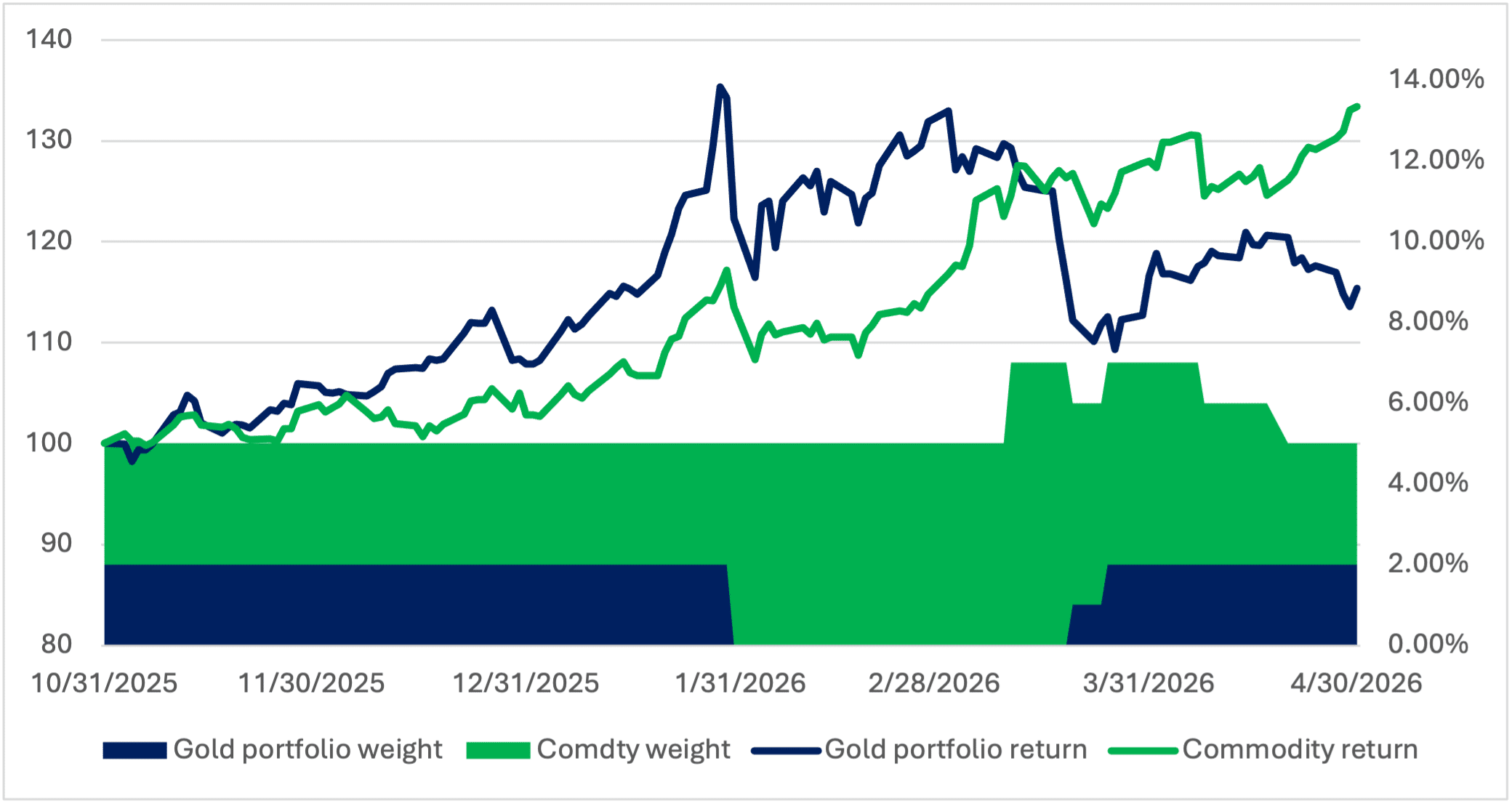
Source: Schroders, Bloomberg. Excludes equity exposure to gold miners.
Tactical duration and curve steepening
Government bonds are another casualty of the set-and-forget mindset. Treating duration as a permanent defensive anchor can be dangerous when supply shocks push bond yields and equity risks in the same direction.

Source: Schroders, LSEG. Analysis is based on monthly returns data for US equities and bonds from January 1973 to August 2025. US equity return is based on the S&P 500 Index, US bond return is based on the Bloomberg US Treasury Index. Past performance is not a guide to future performance and may not be repeated.
While the post-pandemic period has demonstrated that bonds do not always diversify equity risk, the breakdown of negative stock-bond correlations has not rendered bonds obsolete. Actively managed, they continue to provide carry, capital gains potential and diversification benefits.
In this environment, we shifted our fixed income approach away from broad macro bets and towards targeted curve positioning. During the Iran conflict, we used market volatility to reduce interest-rate exposure at the front end of curves across major developed markets, reflecting the view that higher oil prices would push inflation and bond yields higher.
As market expectations adjusted and rate hikes became increasingly priced in, we subsequently added back interest-rate exposure, particularly in shorter-dated bonds where valuations had become more attractive.
The lesson is simple: duration cannot be viewed as a permanent allocation. It must be managed dynamically as economic conditions evolve.
The US Dollar as a positive carry hedge
Movements in bonds and currencies are deeply interconnected. During the Iran crisis, we viewed the US dollar as a beneficiary of safe-haven demand and adjusted currency exposures accordingly.
Despite the previous year’s “Sell America” narrative, the US dollar resumed its traditional role as a refuge during geopolitical stress. When global trade breaks down or investors seek liquidity, the US dollar remains one of the few currencies capable of absorbing that demand.
Importantly, certain currency positions can provide positive carry while also offering defensive characteristics. In an environment where capital is no longer free, the greenback can serve as a highly efficient hedge, rewarding investors while preserving the potential to appreciate sharply if geopolitical risks intensify.

Source: Schroders, Macrobond, 12 March 2026. Past performance is not a guide to future performance and may not be repeated. The forecasts included should not be relied upon, are not guaranteed and are provided only as at the date of issue. For illustrative purposes only.
Expanding the toolkit: Insurance-Linked Securities (ILS)
Dynamic risk management also requires looking beyond traditional sovereign bonds and currencies.
For this reason, we hold strong conviction in Insurance-Linked Securities (ILS). Unlike traditional credit markets, the performance of ILS is linked to natural catastrophe outcomes rather than corporate earnings, central bank decisions or equity valuations.
This makes ILS fundamentally different from most other asset classes. The return stream is driven by a distinct set of risks, providing genuine diversification benefits at a time when many traditional defensive assets have become more correlated.
Importantly, ILS can offer attractive income while maintaining a lower drawdown profile and limited dependence on broader market movements.
Capturing an insulated income stream while remaining largely decoupled from equity market beta is a compelling example of how modern diversified portfolios should be constructed.

Source: LHS – Schroders Capital, Federal Reserve Bank of St. Louis, BofA Merrill Lynch, 31 December 2025. Diversification cannot ensure profits or protect against loss of principal. RHS – Schroders, LSEG Datastream, ICE Data Indices, J.P. Morgan, Credit Suisse. Data as at 30 November 2025. All return and volatility figures shown as USD hedged, except EMD Local and MSCI World which are unhedged returns in USD. Past performance is not a guide to future performance and may not be repeated.
Conclusion: Portfolios must adapt
Expecting a single static asset class to perform an unvarying task – relying on equities to generate returns and standard bonds or gold to provide permanent protection – is an outdated luxury from a bygone era.
The post-GFC period of low inflation and unconditional central bank support was a historical anomaly, not the default setting. Looking across centuries of financial history, inflationary cycles, supply disruptions and shifting asset correlations are normal features of the global economy.
To protect purchasing power and grow real wealth over time, staying static is no longer a viable defensive strategy. Investors must possess the flexibility to scour the full asset horizon, and the active conviction to choose their hedges wisely.
More information: This document is issued by Schroder Investment Management Australia Limited (ABN 22 000 443 274, AFSL 226473) (Schroders).
DOWNLOAD SIAA Monthly – August edition PDF
BACK TO SIAA MONTHLY – AUGUST 2026