

By Joseph Marassa, ETF Strategy Analyst, Global X ETFs
The Cybersecurity sell off
Cybersecurity and broader software stocks came under pressure from mid-2025 to early 2026 as investors worried frontier AI models could commoditise parts of the security stack. These concerns intensified following Anthropic’s Claude Code Security and Claude Mythos Preview announcements, with testing reportedly identifying thousands of previously unknown vulnerabilities across major operating systems and web browsers.[1]

Source: Bloomberg data as of 16 October 2026. Past performance is not a reliable indicator of future performance. The performance data shown is past performance only in Australian dollar terms. Fund inception date is 11 September 2023. Fund returns are calculated on the Net Asset Value (NAV) of the Fund and include any fund distributions. Fund returns are net of management fees and indirect costs and do not include any fees or spreads incurred when buying/selling on an exchange. Refer to the product disclosure statement for a complete list of fees and costs.
The effect has been pronounced in the Australian ETF market, with the cybersecurity category recording its weakest quarter of flows in Q3 2026 extending the outflows that began in Q2.

Source: ASX, TMX as of 30 September 2026.
Was the sell off warranted?
Since it’s April low, the Global X Cybersecurity ETF (BUGG) has rallied over 90%[2], extending its gains in September after Anthropic CEO Dario Amodei raised safety issues about the pace of AI development, a position Sam Altman and Elon Musk quickly backed.[3]
| 1y p.a. | 3y p.a. | Since Inception p.a. | |
| BUGG Total Return | 36.41% | 27.6% | 22.18% |
Source: Global X data as of 27 October 2026. Past performance is not a reliable indicator of future performance. The performance data shown is past performance only in Australian dollar terms. Fund inception date is 11 September 2023. Fund returns are calculated on the Net Asset Value (NAV) of the Fund and include any fund distributions. Fund returns are net of management fees and indirect costs and do not include any fees or spreads incurred when buying/selling on an exchange. Refer to the product disclosure statement for a complete list of fees and costs.
Investor concerns were not without merit though. AI-powered tools are becoming increasingly effective at vulnerability discovery and code review. These functions, however, represent only around 10% of the total addressable market (TAM) according to Morgan Stanley estimates, suggesting the reaction to Anthropic’s announcements may have overstated the disruption facing the entire cybersecurity sector. [4]
The fundamentals tell a similar story. Between the July 2025 peak and April 2026 trough, the blended 12-month forward earnings estimates for BUGG’s underlying index rose 21%, suggesting prices fell on sentiment, not on deteriorating earnings expectations.[5]
The advantage of established players
While AI disruption has so far centred on vulnerability detection, wider adoption is expanding security needs elsewhere, particularly identity and governance. Incumbents hold a structural advantage here because years operating within customer environments have given them proprietary data and platforms embedded across complex enterprise workflows.[6] Demand also appears to favour established vendors. Around 30% of CISOs surveyed by McKinsey lack confidence in existing controls for emerging AI risks, yet organisations are looking to vendors rather than building solutions internally.[7] For established providers with existing customer relationships and integrated platforms, securing AI therefore represents a natural extension of their existing offering.
AI remains a tailwind for cybersecurity
Much of the debate has focused on whether AI will disrupt cybersecurity, but the more important question may be whether AI can scale without it. Autonomous AI agents increasingly require access to company data and systems, creating a new identity challenge and opportunity for Identity and Access Management (IAM). Unlike traditional users, AI agents operate autonomously and continuously across systems, requiring access to be evaluated in real time rather than trusted for an entire session. [8] As enterprises deploy more agents, these non-human identities will need to be authenticated, governed and monitored, making identity security increasingly important to the broader AI buildout.
The scale of the challenge is already significant. AI agent identities are estimated to outnumber human identities by 100 to 1[9], yet according to IBM, fewer than half of organisations report securing NHIs within AI workflows.[10]
This gap is where the opportunity lies, further highlighted by Morgan Stanley estimates of the total addressable market. In its base case, Morgan Stanley expects the agentic identity opportunity to lift the total identity market from just over US$20bn today to more than US$60bn by 2030, a 28% CAGR.
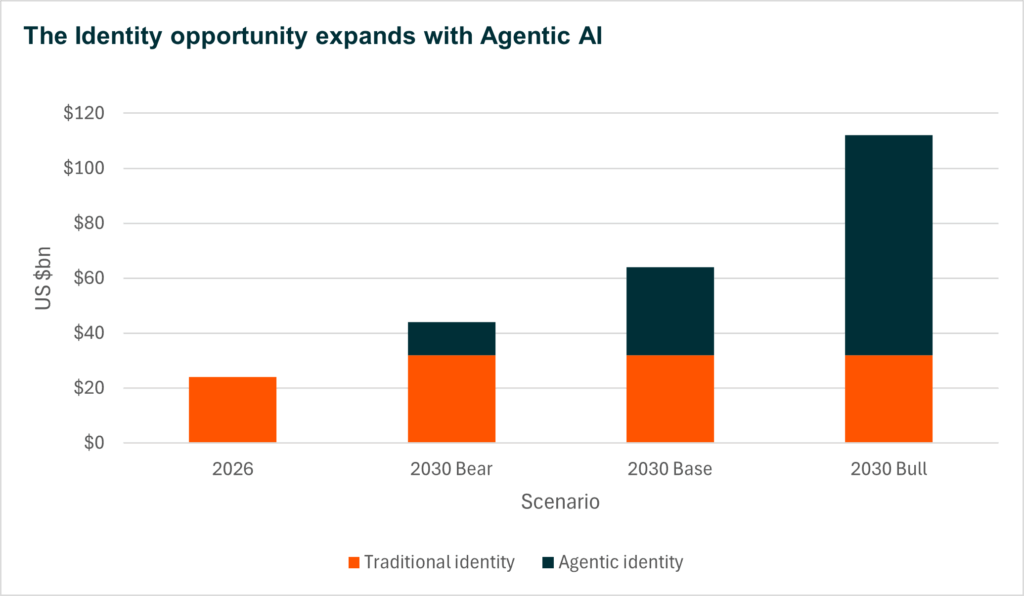
Source: Morgan Stanley. Forecasts are not guaranteed, and undue reliance should not be placed on them. This information is based on views reasonably held by Global X as at 29/10/2026.
Furthermore, while overall cybersecurity budgets are forecast to grow at a CAGR of around 2.5% over the next three years, the share allocated to AI agent security is expected to more than triple to 15%.[11]

Source: McKinsey & Company. Forecasts are not guaranteed, and undue reliance should not be placed on them. This information is based on views reasonably held by Global X as at 29/10/2026.
Justifying valuations
Cybersecurity continues to trade at a premium to the broader market on a 34.8x forward P/E versus 18.5x for global equities.[12] Against its own history, however, the valuation does not seem stretched. The current multiple is now in line with its average of 34.5x and well below the 40-66x range that held through early 2023. After such a strong rally, some investors may feel they have missed the trade. However, if the tailwinds outlined above play out, earnings growth could support current valuations and leave scope for further re-rating, indicating the opportunity may still have room to run. Therefore, cybersecurity may prove to be a necessary speed bump in the AI buildout, rather than one of its casualties.
Considerations for investing
All investments involve risk. An investment in this fund may be affected by risks related to: Markets, Investment Objective, Index Tracking, ETF Pricing, Liquidity, Currency, Concentration, & Emerging Markets. The nature and level of risk may vary depending on the fund’s investment strategy and assets. The value of your investment can rise or fall, see the PDS for a full list of risks.
[1] Anthropic. Securing critical software for the AI era. (n.d.)
[2] Bloomberg data as of 09 October 2026
[3] CNBC. AI stocks sink while cybersecurity shares rally on slowdown fears. (14 September, 2026)
[4] Morgan Stanley. AI-Natives: Challengers, or Creating Challenges, for Cyber. (20 April, 2026)
[5] Bloomberg data as of 16 October 2026
[6] Vista Equity Partners. Software’s Staying Power Through the Agentic Era. (August 27, 2026)
[7] McKinsey & Company. Securing the agentic enterprise: Opportunities for cybersecurity providers. (March 24, 2026)
[8] Okta. The role of AI in IAM: Securing the agentic frontier. (n.d.)
[9] IBM. Securing the agentic enterprise starts with identity. (09 September, 2026)
[10] IBM. Cost of a data breach Report 2026. (n.d.)
[11] McKinsey & Company. Securing the agentic enterprise: Opportunities for cybersecurity providers. (March 24, 2026)
[12] Bloomberg. As of October 16. Global equities represented by MSCI World index.
