

Provided by FCX
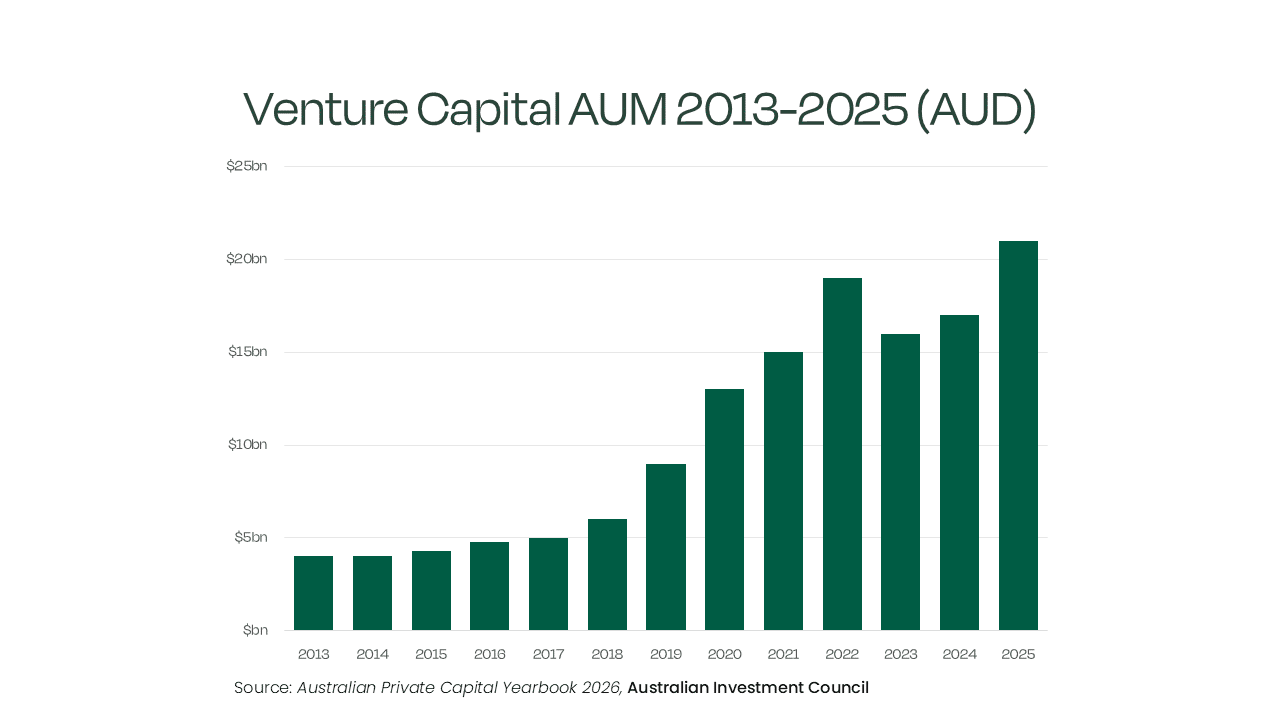
Australian private markets have consistently grown over the last 10 years, and private capital pools have grown too, with VC assets under management (AUM) sitting at ~A$21 billion in 2025.
As this space continues to grow, investors look to find a way to turn this capital into financial returns.
Traditionally, the pathway to this was through IPOs or exits. However, with more companies opting to stay private for longer, investors can have cash ‘trapped’ in companies, with no way to access it.
A recent AFR article [https://www.afr.com/technology/major-canva-backer-says-tech-giant-has-no-need-to-go-public-20260519-p5zypz], major Canva backer Hemant Taneja, CEO of General Catalyst, stated that “We’re investors in Stripe and many companies that can perfectly thrive in the private markets and do everything they need to do. So, I don’t see what the necessity is to go public”.
As a result of this, investors have started to turn to secondary transactions to realise returns.
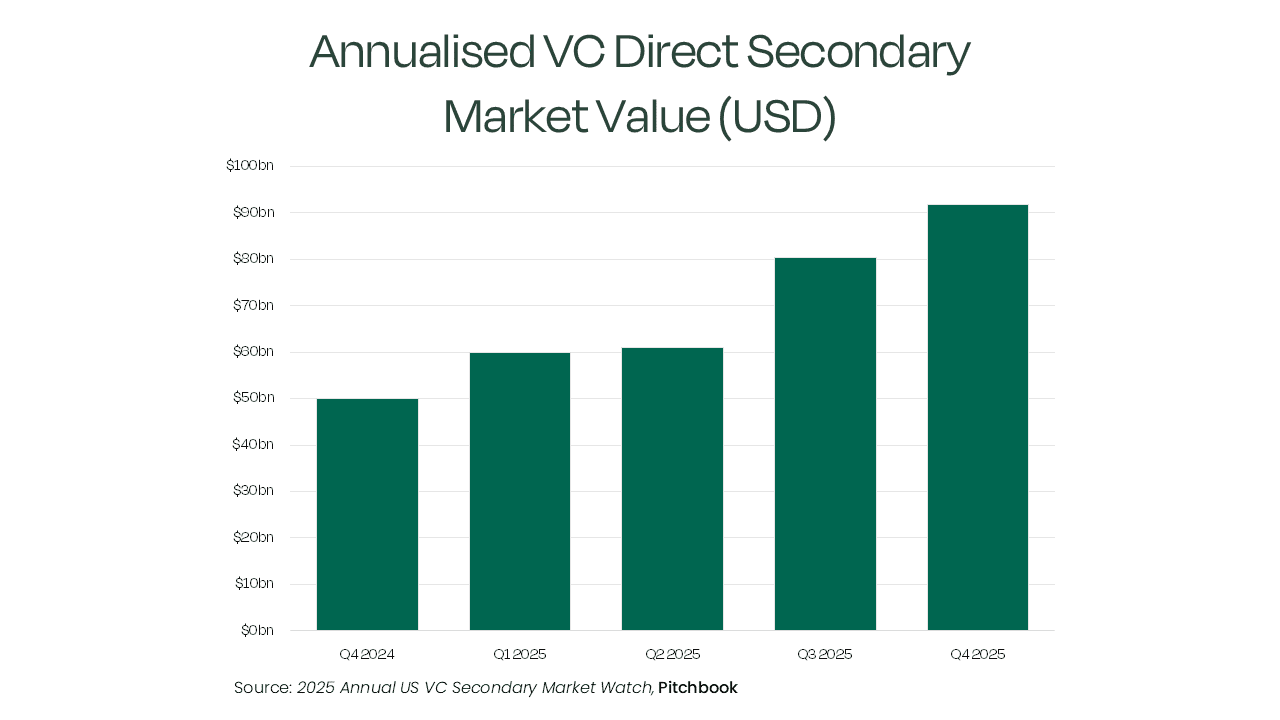
The graph below shows the speed at which secondaries are growing – annualised VC direct secondary value went from US$50 billion in Q4 2024 to US$92 billion in Q4 2025 – an 83% increase.
The need for regulation in secondary markets:
The rapid growth of secondaries has attracted some scrutiny. These transactions can happen informally or without the correct infrastructure, and this brings many risks to investors.
As FCX CEO David Ferrall wrote on LinkedIn – private markets often lack the efficiency and regulation that public markets offer – this is the next step needed to ensure that companies can stay private and complete secondary transactions with confidence.
Without proper regulation, pricing can become significantly less transparent, with no reference point as to what a share is actually worth. Compliance obligations, such as AML and KYC, become significantly more difficult to meet when the buyer and their source of funds aren’t properly verified. Companies can also face significant regulatory issues if a transaction they weren’t aware of later creates a problem.
These consequences were seen in a recent example where Anthropic, one of the world’s largest private companies, has voided all unauthorised secondary sales of its shares, despite investors being led to believe they had validly purchased exposure through secondary platforms.
The message is clear: without company approval, secondary transactions can be unwound. Anthropic’s actions demonstrate why private market secondary trading needs proper regulation, transparency and company-authorised market infrastructure. Read more on LinkedIn here.
A structured, regulated environment solves each of these problems – bringing transparency, efficiency and trust to all parties involved.
What is FCX and how does it provide a solution to this?
FCX is defining the next generation of private markets in Australia: the country’s first and only regulated platform for private secondary transactions in companies and funds.
FCX holds both an Australian Market Licence and a Clearing and Settlement Facility Licence, issued by ASIC and the RBA. This makes FCX the only operator in Australia other than the ASX that has complete market and clearing and settlement capabilities.
This means every secondary transaction on FCX happens within a clear regulatory framework, with proper KYC and AML checks, transparent pricing, and automated settlement via Distributed Ledger Technology.
FCX eliminates the manual processes and compliance risks that define unstructured secondary transactions. Companies and funds retain control over who can access their register, while investors and sellers gain certainty through a properly authorised, compliant and settled transaction.
DOWNLOAD SIAA Monthly – June edition PDF
BACK TO SIAA MONTHLY – JUNE 2026