

Provided by Global X
For much of the past decade, investors have largely been forced to pick a side. Growth or value. Momentum or quality. Yet markets rarely move in straight lines, and the rotation between styles has reinforced an important lesson for investors that factor timing is notoriously difficult.
That reality is helping fuel growing interest in multi-factor solutions like Growth at a Reasonable Price (GARP) investing – an approach popularised by legendary investors such as Peter Lynch and echoed by Warren Buffett. Rather than chasing the fastest-growing companies regardless of price, or buying cheap businesses with deteriorating fundamentals, GARP aims to identify quality businesses with sustainable earnings growth trading at sensible valuations. In many ways, it sits between growth and value investing, combining the best characteristics of both styles.
The timing may be particularly relevant today. Global equity valuations remain elevated relative to long-term averages, especially across parts of the US market where enthusiasm surrounding artificial intelligence has driven some valuations higher. Historically, higher starting valuations have often translated into lower forward returns, meaning investors should be cognisant that valuation discipline still matters.
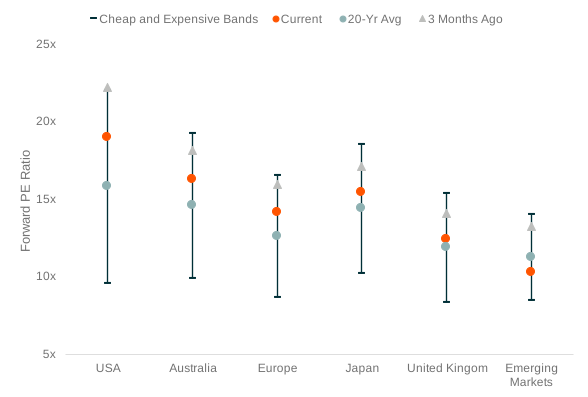
Source: Bloomberg as of 30 April 2026. Past performance is not a reliable indicator of future performance.
Abandoning growth entirely is difficult given structural trends in AI and automation. Investors still need compounding earnings exposure, but the key challenge is avoiding overpaying, which is where GARP seeks to strike a balance.
From single factors to smarter blends
The rise of factor-based investing has been one of the defining themes within the Australian ETF industry. Factor ETFs now account for a fifth of all equity ETF assets, reflecting growing investor demand for systematic, rules-based strategies that seek to replicate what active managers have traditionally attempted to do, but in a transparent and lower-cost structure.
Early factor investing focused on single characteristics such as value, momentum, quality or low volatility, but these can underperform for extended periods depending on the cycle. Value struggled post-GFC, while growth was hit hard during the 2022 rate shock. GARP evolves this approach by blending growth, valuation discipline and quality into a more balanced framework.
In practice, this can create portfolios that are more resilient across varying market conditions. Historically, GARP strategies have demonstrated an ability to participate strongly during market recoveries while also exhibiting relatively defensive characteristics during drawdowns compared to pure growth strategies.
Why GARP matters for Australian investors
The investment case for GARP may be particularly compelling for Australian investors given the structural composition of the local sharemarket. Australia has historically been the land of income given its heavy concentration in financials, resources and defensive yield-oriented sectors. While these sectors have delivered attractive dividend income over time, earnings growth has been comparatively modest.
Since the GFC, Australian corporate earnings growth has averaged roughly 4% p.a. compared to approximately 11% p.a. for the broader global sharemarket. That divergence highlights a key challenge facing domestic investors – genuine growth businesses can be relatively scarce.
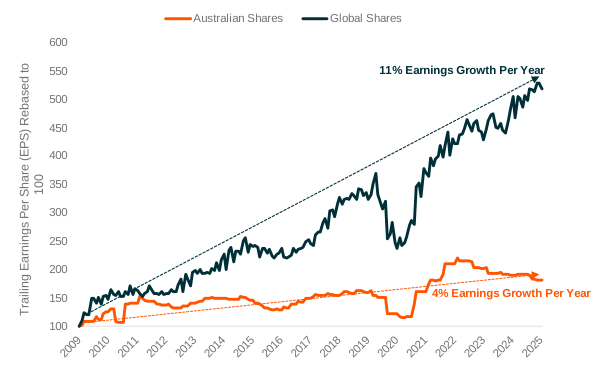
Source: Bloomberg accurate as of 30 April 2026 using S&P/ASX 200 index and MSCI World ex Australia Index. Past performance is not a reliable indicator of future performance.
For investors already heavily exposed to broad Australian equity indices, adopting a GARP allocation may provide a useful growth tilt without fully abandoning valuation discipline.
Equally important is ensuring any additional ETF exposure genuinely complements an investor’s existing portfolio rather than simply replicating it. With the ETF market expanding rapidly and new funds launching regularly, many investors may unknowingly be increasing overlap rather than diversification.
A thoughtfully constructed GARP allocation can potentially provide differentiated exposure by tilting towards companies with stronger earnings growth and quality characteristics while maintaining valuation awareness. In other words, investors should ask whether an additional ETF is adding something genuinely new to the portfolio or merely repackaging exposures they already own.
A disciplined framework in an expensive world
Markets inevitably move through cycles. Growth leadership eventually cools. Value eventually re-emerges. Quality periodically falls out of favour before regaining importance. GARP does not attempt to predict these rotations perfectly. Instead, it seeks to maintain balanced exposure to companies capable of growing earnings sustainably without demanding excessive valuations.
That discipline has historically produced compelling long-term outcomes. Historically, GARP strategies have outperformed the broader market across 100% of rolling 10-year periods analysed, highlighting the strength of combining growth, quality and valuation into a single investment framework. Importantly, that performance has not simply come from taking on excessive risk, as GARP strategies have historically delivered strong risk-adjusted returns compared with other factors and the broader market.
In a market environment still characterised by elevated valuations, investors can easily be tempted to stretch further for growth and pay increasingly higher multiples for future earnings. GARP offers a more disciplined alternative, seeking companies with durable growth potential, but without paying an arm and a leg for them. Rather than chasing speculative momentum or relying purely on cheap valuations, the approach aims to systematically identify businesses where growth and price remain in balance.
Issued by Global X Management (AUS) Limited (‘Global X’) (AFSL 466778, ACN 150 433 828). This is general information only and not personal advice. This communication doesn’t consider your personal circumstances or needs. Investors should consider whether Global X products are appropriate for them, obtain financial advice and read the product disclosure statement (PDS) and target market determination (TMD) before making investment decisions. All PDSs and TMDs are available on our website: www.globalxetfs.com.au. Investment in any products issued by Global X is subject to risks, including possible delays in repayment and loss of income and principal invested. Past performance is not a reliable indicator of future performance. This content may not be reproduced, distributed or published by any recipient for any purpose. Global X nor any of its affiliates make any warranty as to the accuracy of any data used or displayed in this communication or to the performance of any product.
